For salons, lash brands, ecommerce sellers and distributors, quality is not only about one good sample. The real goal is to keep curl, length, thickness, finish, tray presentation and packaging details stable from sample approval to repeat orders.
Quick answer: lash quality control should inspect the approved sample, curl retention, thickness feel, fibre finish, tray alignment, packaging text, carton records and reorder reference before a wholesale buyer approves repeat production.
What a buyer can verify without a laboratory
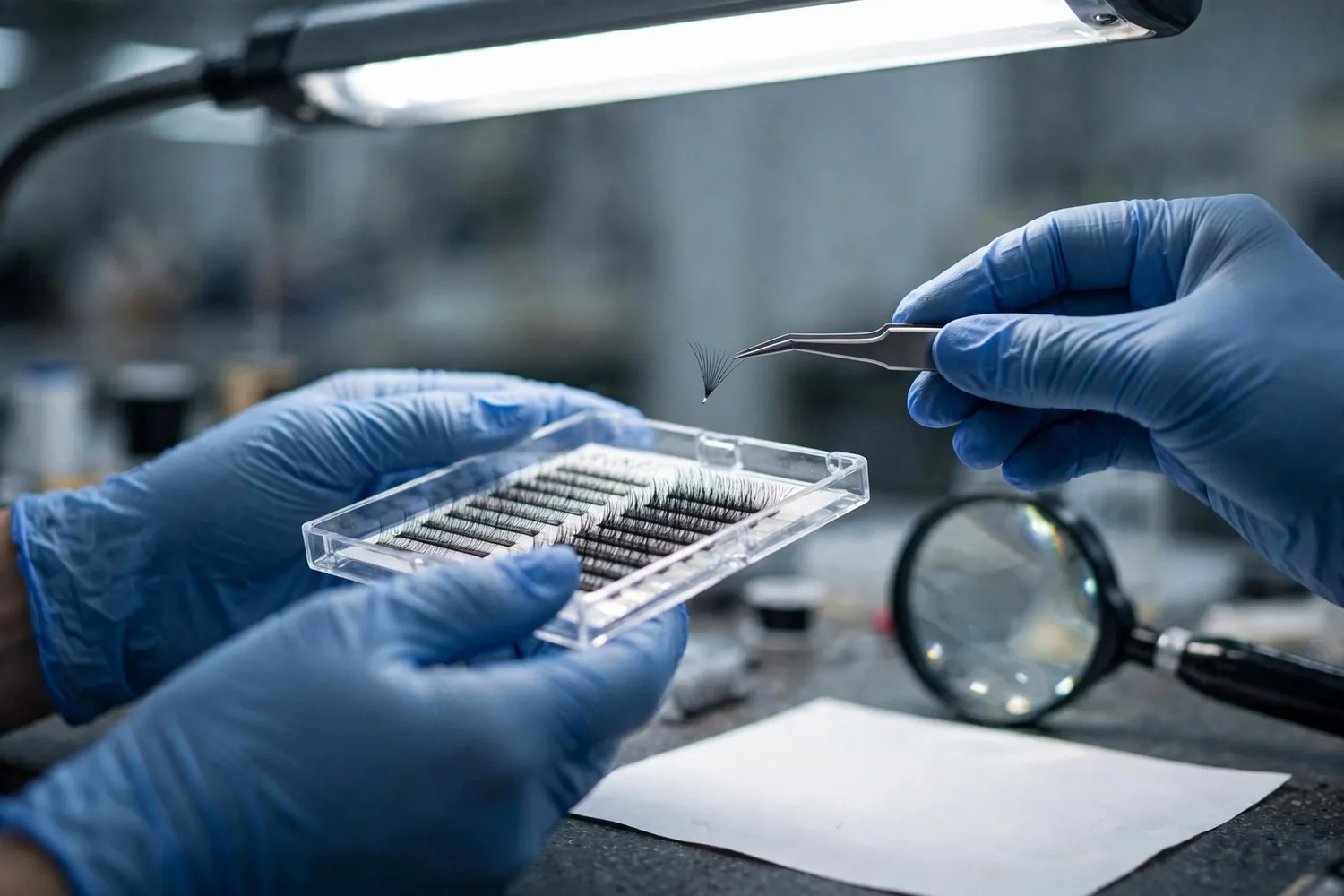
Most quality claims in this category cannot be independently confirmed. What can be confirmed is production control, and several signals for it are visible on a sample tray with no equipment at all.
Diameter consistency. Pick fans from different rows and compare fibre thickness by eye against a light background. A controlled batch varies minimally. Diameter is the variable most likely to change the weight of a set without changing the D label, so variation here is worth noticing early.
Base consistency. Compare base width across ten or fifteen fans. A tray where some bases are visibly wider usually indicates the bonding step was not held to one setting. Look also for fibres sitting outside the bond — one or two is handling, a pattern across many fans is not.
Curl consistency. Lay several fans flat and compare where the curve begins along the fibre. Curl that starts at different points reads as uneven on a set even when the specified curl is correct. Check the top and bottom rows separately, because trays are filled in sequence and inconsistency between rows can indicate a batch assembled from more than one run.
None of these confirm material composition, and none predict retention over four weeks. Treat them as a filter that decides whether a sample is worth wearing, not as a substitute for wearing it.
Why Quality Control Matters Before Bulk Orders
Wholesale buyers should not judge a lash supplier by price alone. A useful supplier helps you compare samples, confirm product specifications, review packaging, document approved details and reduce the risk of inconsistent repeat orders.
| Quality Area | What B2B Buyers Should Check |
|---|
| Curl retention | Compare curl stability across sample trays and confirm it matches your salon or brand positioning. |
| Fibre finish | Review matte, satin or glossy appearance in real product photos and ecommerce listings. |
| Strip pickup | Test whether lashes release cleanly from the strip and support professional application. |
| Packaging accuracy | Confirm tray label, custom box, logo placement, insert cards and product naming before production. |
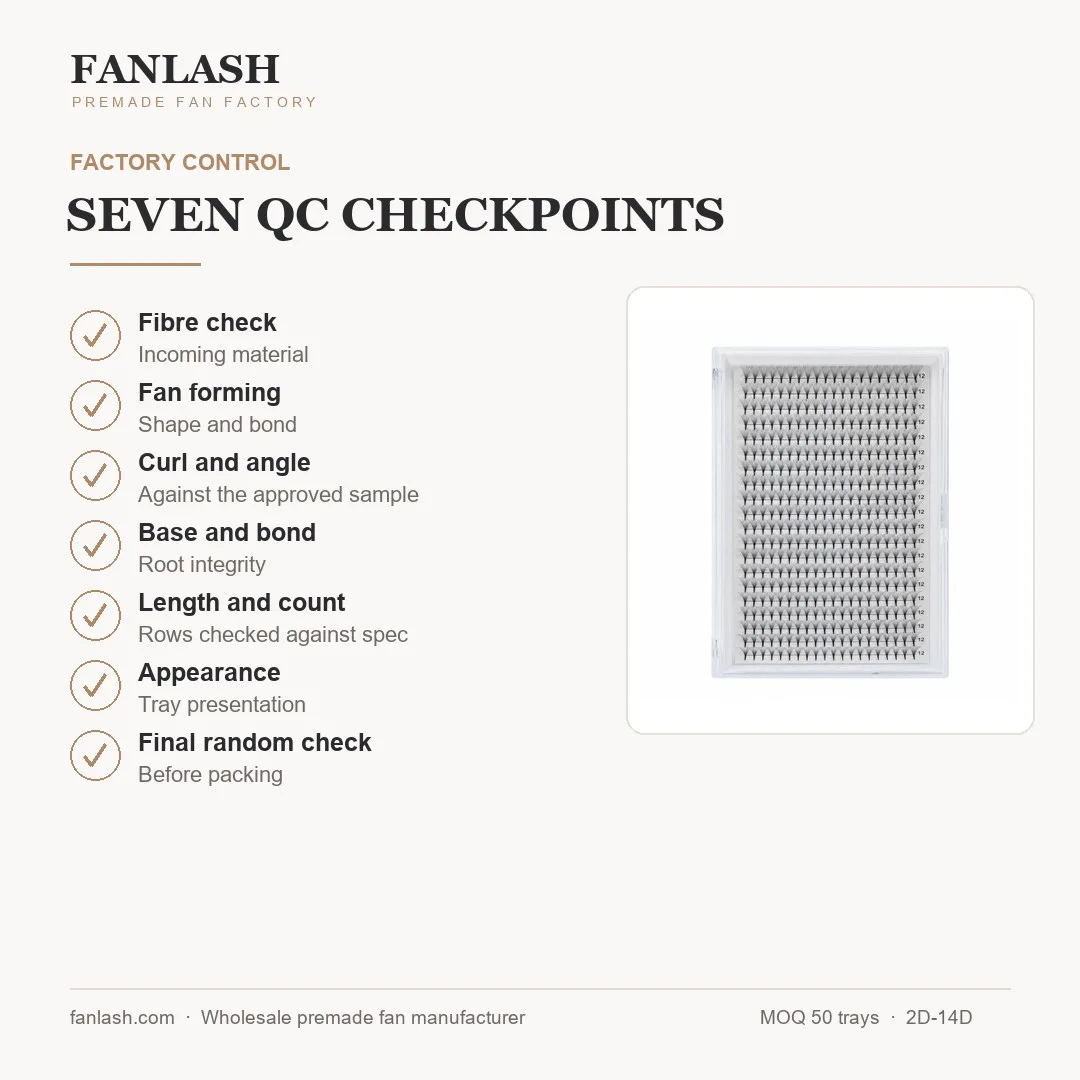
Our 7-Step Quality Control Process
01 RAW MATERIAL
Check fibre, curl and diameter
Incoming BSF.T fibre is inspected for diameter consistency, curl direction and surface finish before production begins.
02 IN-PROCESS
Check fan forming and bonding
Fan symmetry, base shape and bonding strength are checked during production, not after.
03 CURL & ANGLE
Ensure consistent curl and symmetry
Curl direction and angle are compared across the tray so the whole batch matches the approved sample.
04 BASE & BOND
Check base size and bonding strength
Base width and bonding consistency are verified — a bulky or unstable base affects placement comfort.
05 LENGTH & COUNT
Verify length accuracy and fan count
Length labels, row layout and fan count are checked against the tray specification.
06 APPEARANCE
Inspect for defects and cleanliness
Visual inspection covers stray fibres, dust, deformation and tray cleanliness.
07 PRE-PACKING
Final random check before packing
Random samples from the finished batch are checked again before trays are sealed and boxed.
From Sample Approval To Repeat-Order Consistency
The most useful quality control process is practical: approve a sample, document its specifications, confirm packaging, then repeat the approved product as closely as possible in later wholesale orders.
Best practice: keep a written approval record for curl, length, thickness, finish, tray label, box design, insert card and any OEM / private label packaging details. This record is what protects your repeat orders.
Related Pages For Quality-Focused Buyers
What Quality Control Can And Cannot Prove
Most quality claims in this category cannot be independently confirmed by a buyer. What can be confirmed is production control, and production control leaves evidence: a consistent tray, a documented specification, a sample held on file, and a process that inspects against those documents rather than against an impression.
That distinction should shape how you read any supplier's quality page, including this one. No inspection step proves how a fan behaves after four weeks of wear. No check confirms material composition from a photograph. What a controlled process does is make the product predictable, batch after batch, which is the property a wholesale buyer actually needs.
FanLash runs seven inspection points across production. They exist because the failures that damage a brand are rarely dramatic; they are small drifts in base width, curl start, diameter or count that pass on the first order and accumulate by the third.
The 7 Checks In Order
**01 Fibre check.** Incoming fibre is inspected before production begins. Diameter consistency, curl direction and surface finish are compared against the specification the batch is being produced for. A fibre variation caught here is a batch corrected; the same variation caught at packing is a tray rejected.
**02 Fan forming.** Fan symmetry and the shape of the fan as it forms are inspected during production rather than after. Forming is where spread is decided, and spread that varies within a tray reads as uneven on a finished set even when the density label is correct.
**03 Curl and angle.** Curl direction and the point along the fibre where the curve begins are compared across the tray. Curl is a specification value, but where the curve starts is a production property, and it is the property buyers notice when a set looks inconsistent.
**04 Base and bond.** Base width and bonding consistency are checked together, because a base that is too wide and a bond that is uneven cause the same symptom: a fan that does not sit cleanly and does not hold its shape on pickup. Base width is also the variable most likely to change application speed without changing any number on the label.
**05 Length and count.** Length labels, row layout and fan count are checked against the tray specification. A tray that is short on count changes the cost per set, and a length that drifts changes how a set reads on the eye. Both are checkable without equipment, which is why they belong in the inspection rather than in the complaint.
**06 Appearance.** Visual inspection covers stray fibres, dust, deformation and tray cleanliness. This is the check that decides whether a tray looks like a product a brand can put its name on. It is also the check most easily skipped when a line is under pressure, which is why it is written into the sequence.
**07 Final random check.** Before trays are sealed and packed, random samples from the finished batch are inspected again. The point of a final check is not to repeat the previous six; it is to catch what packing, handling and time in the works have done to a batch that was correct when it left the line.
Where Each Check Sits In Production
The sequence is not a list of equal steps. Checks one and two sit at the start, where a correction is cheap and affects the whole batch. Checks three to five sit inside production, where a correction affects the trays currently running. Checks six and seven sit at the end, where a correction can only reject.
That asymmetry is the reason the early checks carry more weight than their position in a list suggests. A fibre or forming problem found at the start is a batch that never gets made wrong. The same problem found at final inspection is a batch that has already consumed production time, and a decision about what to do with it.
Buyers should read a quality process the same way. Ask which checks happen before production, which happen during, and which happen at the end, because that answer tells you how much of the process is prevention and how much is screening.
What A Buyer Can Verify Without Equipment
Several signals are visible on a sample tray with no equipment at all, and they are worth checking before you rely on any supplier's description of its process.
**Diameter consistency.** Pick fans from different rows and compare fibre thickness by eye against a light background. A controlled batch varies minimally. Diameter is the variable most likely to change the weight of a set without changing the D label.
**Base consistency.** Compare base width across ten or fifteen fans. A tray where some bases are visibly wider usually indicates the bonding step was not held to one setting. Look also for fibres sitting outside the bond: one or two is handling, a pattern across many fans is not.
**Curl consistency.** Lay several fans flat and compare where the curve begins along the fibre. Check the top and bottom rows separately, because trays are filled in sequence and inconsistency between rows can indicate a batch assembled from more than one run.
**Count and layout.** Count a row and multiply. A tray that is short on count is a tray that changes your cost per set, and it is the cheapest thing on this list to verify.
None of these confirm material composition, and none predict retention over four weeks. Treat them as a filter that decides whether a sample is worth wearing, not as a substitute for wearing it.
One Standard Across Six Factories
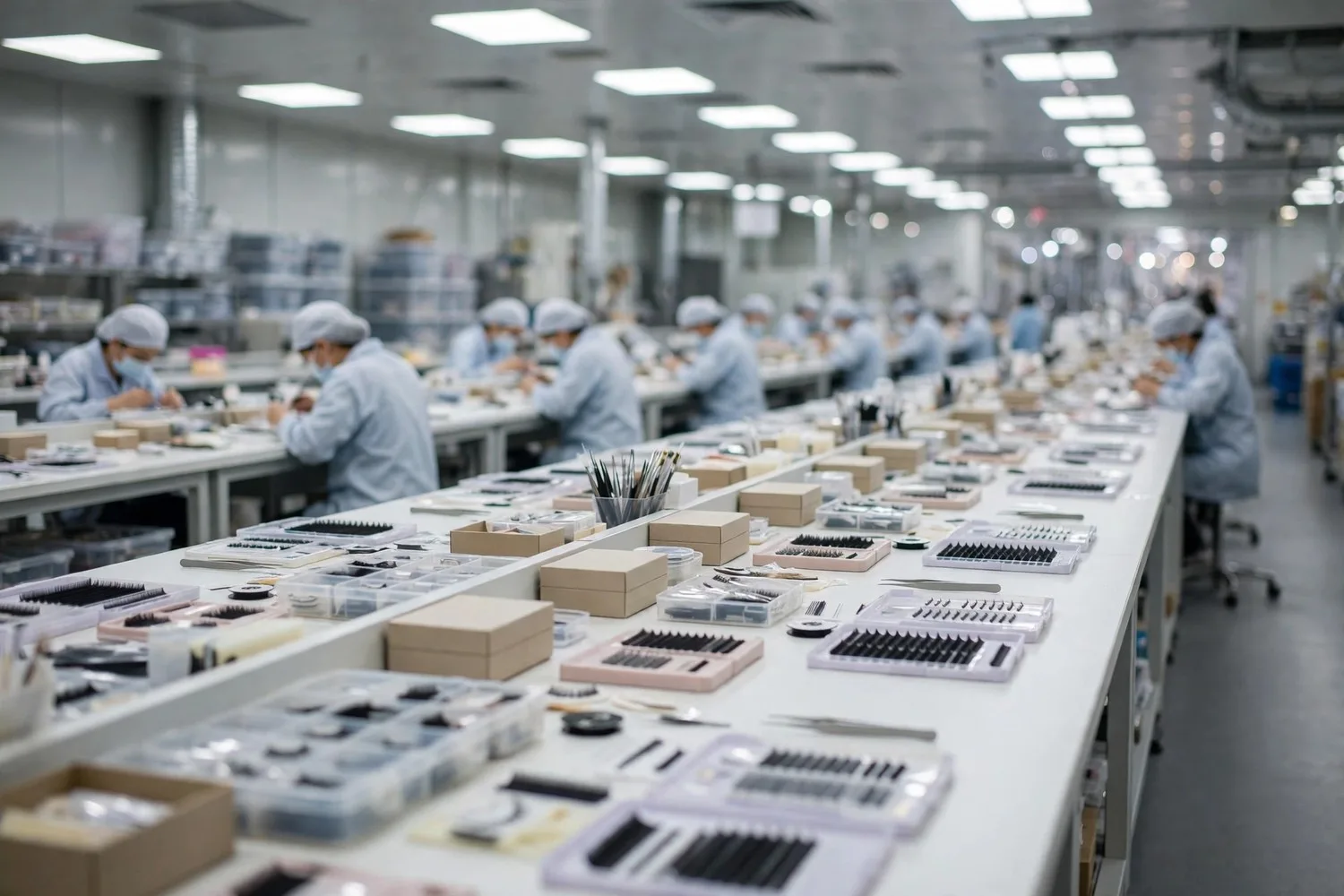
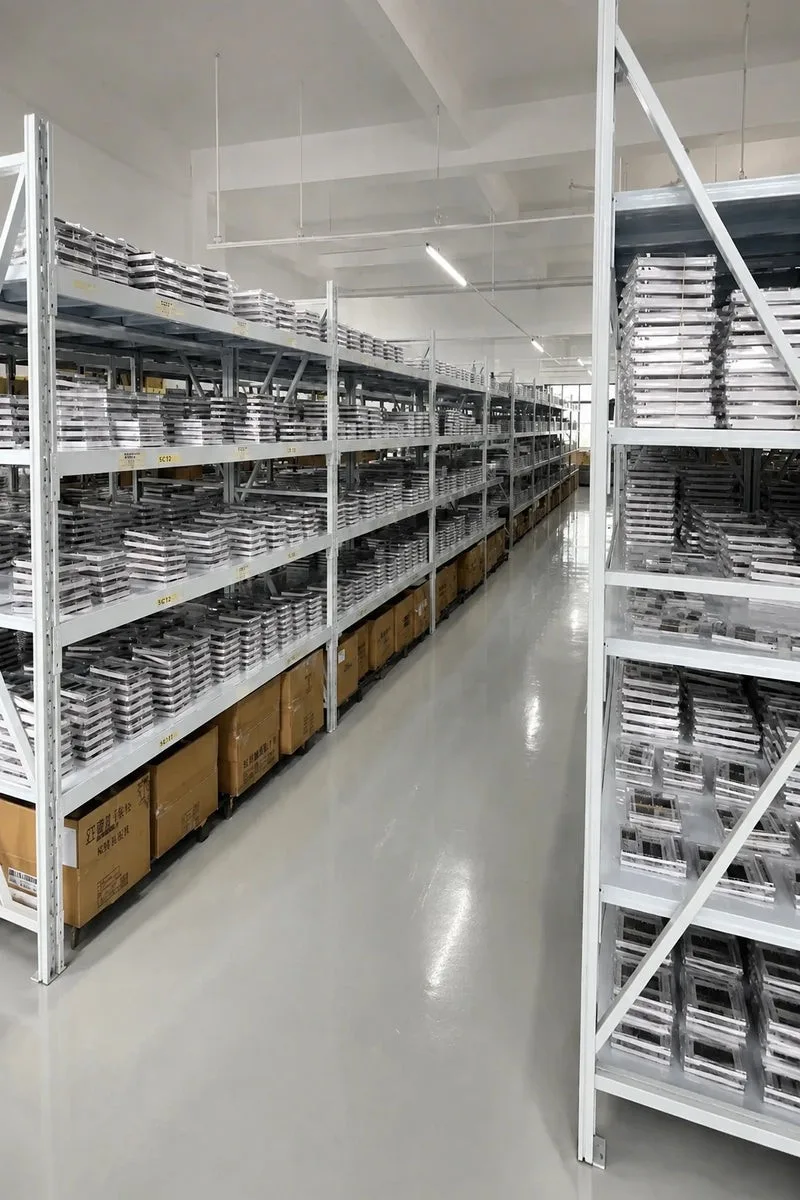
FanLash produces across six branch factories with a combined production area of 1,980 m² and 170+ staff. Scale is only an advantage if the standard is shared, because the failure mode of a multi-site operation is that each site is internally consistent and externally different.
The defence is the same document everywhere: the specification sheet that a batch is produced against, and the approved sample that the sheet refers to. When every site inspects against the same reference rather than against local habit, a tray from one site can be compared with a tray from another, which is what a buyer placing a repeat order is effectively doing.
This is also why the specification work on the private label side and the inspection work on this page are the same discipline. A quality process without a written specification inspects against opinion. A specification without inspection is a document nobody checks.
What Records Travel With A Repeat Order
A repeat order is a comparison, and a comparison needs two sides. One side is the tray being produced; the other is the approved reference. What travels between them is the record.
The useful record identifies the product specification, the approved sample, the packaging version, and where applicable the artwork proof. It is short enough to read and specific enough to inspect against. A record that says premium quality is not a record; a record that says 8D, 0.07, C curl, mixed length, long stem, mixed tray, with this approved sample, is.
Records also make disagreement resolvable. When a delivered tray does not match, a written specification turns a conversation about impressions into a comparison against a document both sides accepted before production. That is the difference between a claim and a remedy.
Packaging QC Is Not Product QC
Product inspection ends at the tray. Packaging inspection starts there, and it fails in different ways. A tray can be perfect and still ship in a box that does not fit it, carry a label printed for a different specification, or include an insert card that describes a mixed tray when the box holds single-length stock.
Packaging QC therefore inspects against the packaging proof, not against the product. Box structure, finish, label placement, label copy, insert cards and seals are each checked against the approved version, because packaging errors are visible to the end customer in a way that a base-width variation is not.
The ordering matters. Packaging is approved after the product specification, and printed after the packaging proof. A brand that prints early and specifies late is buying a mismatch.
Three Failures Buyers Catch Too Late
**The count failure.** A tray that is short on fans is discovered when a set runs out, not when the tray is opened. It is the easiest failure to check and the most expensive to absorb, because it changes the unit economics of every set your artist builds.
**The drift failure.** A reorder that is close but not the same: base slightly wider, curl starting slightly later, fibre slightly heavier at the same declared diameter. No single tray looks wrong, which is why it passes, and the difference shows up in how sets wear.
**The packaging mismatch failure.** A label, insert or box that describes the previous version of the product. The tray is correct, the packaging is correct in isolation, and the pair is wrong. This is the failure most often created by approving product and packaging as separate projects.
All three are prevented by the same thing: a written specification, an approved physical sample, a packaging proof with a version, and inspection against those rather than against a general impression of quality.
QC FAQ
**How many inspection steps does FanLash run?** Seven: fibre, fan forming, curl and angle, base and bond, length and count, appearance, and a final random check before packing.
**Can I inspect a sample myself?** Yes. Diameter consistency, base consistency, curl consistency and count are all checkable on a tray with no equipment.
**Does the factory produce in one location?** Production runs across six branch factories with a combined area of 1,980 m² and 170+ staff, inspected against the same specification.
**What densities can be produced?** Stock covers 4D, 5D, 7D, 8D, 9D, 10D and 12D across four stem types and two tray formats. Custom production covers any density between 2D and 14D.
**Does packaging go through its own inspection?** Yes. Packaging is inspected against the packaging proof — box structure, finish, label placement and copy, insert cards and seals — separately from the tray inspection.
**How do I keep a reorder consistent?** Approve a physical sample, record the specification in writing, keep the packaging proof versioned, and order against that reference.
**What if a delivered tray does not match the approved sample?** Compare it against the written specification and the approved sample rather than against memory, then raise it with the batch and tray details. A documented specification is what turns a difference into something describable, and therefore correctable.
Request A Quality Sample
Tell us your market and product interest, and we send a sample kit so you can run your own checks: base consistency, spread, curl, diameter and count.
If your specification is not settled, send the brief you have. A sample built around a working brief is more useful than one built around a complete-looking form.
Request Quality Sample